Accounting software deployment at ZoopCoder starts at ₹1,00,000, with maintenance plans at ₹3,000 / ₹8,000 / ₹15,000+ per month. The English demo on this page shows 12 admin screens in 3 minutes 22 seconds, of which 10 are real accounting screens — Dashboard, Products, Customers, Invoices, Expenses, Reports, Transactions, Quotations, Imports and Units — and 2 are interface furniture. That is honest evidence of a sales-side billing and expense system. It is not evidence of the three things an Indian buyer replaces a spreadsheet for: no screen in the recording opens a GST return or any tax setting at all, no ledger, journal or chart of accounts is ever shown, and no profit and loss statement or balance sheet appears — even though the video is titled “Expense Tracking, Profit & Loss and More”. A custom build takes 6–16 weeks. Source code ownership and 30 days of post-launch support are included, with 30/40/30 milestone payments. Before asking for a quote, count the sales invoices you raise in a normal month. Below roughly 20 a month with one bank account, a free invoice tool and your accountant’s spreadsheet still beat a ₹1,00,000 platform.
Full walkthrough · 3 min 22 sec · English
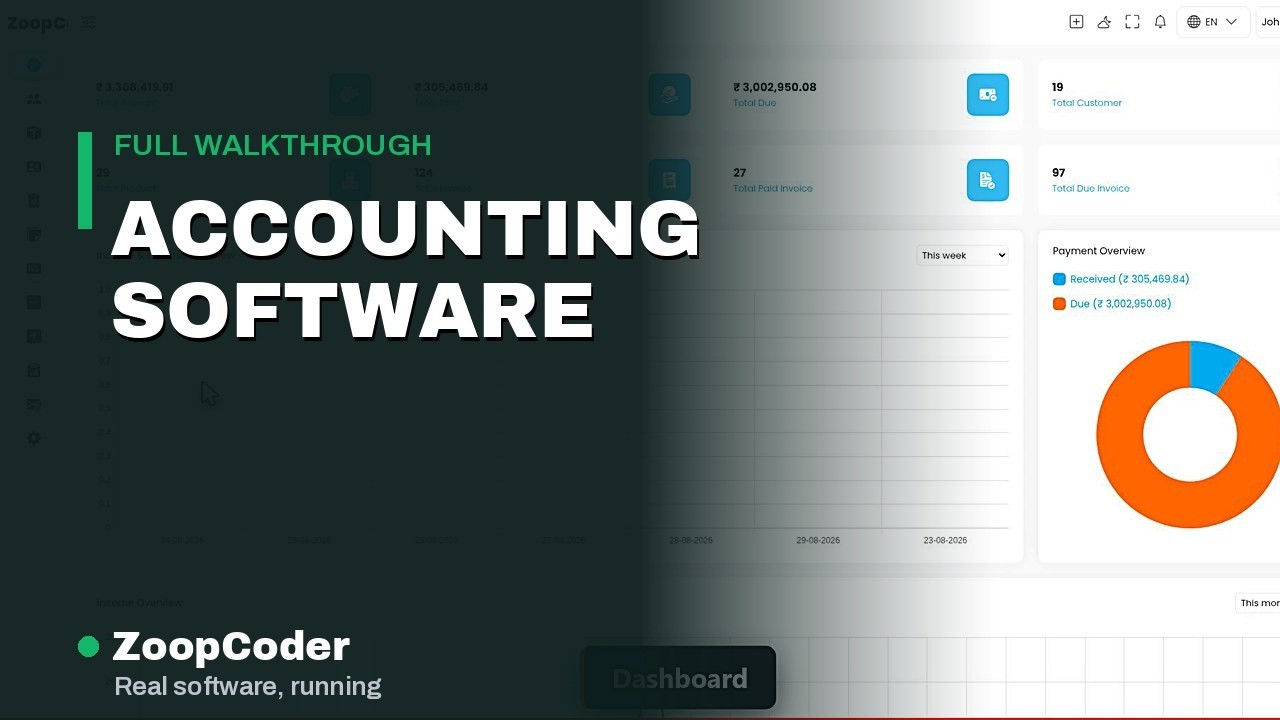
How this page was prepared: ZoopCoder sells deployment and development services. The screen inventory below comes from the recording plan for this published demo; the feature captions on the video are checked against it separately, further down. A screen title establishes which area was opened, not that every workflow in that area was tested. Demo records are not client results.
Start with one month, not a feature list
Take last month and write down what actually happened to your money. How many sales invoices did you raise, and did any of them need a GST rate you had to look up? How many purchase bills came in, and who typed them anywhere? How many lines were on your bank statement, and who matched them to those invoices and bills? What did your accountant ask you for at the end of it, and in what format? Those four answers scope accounting software far more accurately than any comparison table.
They also decide whether you need it. Books software earns ₹1,00,000 when the volume is past the point a spreadsheet can be trusted, when more than one person touches the numbers, or when GST deadlines are being missed because the data is scattered. If you raise a handful of invoices a month and your accountant is content with what you send, buying a platform mostly moves the same typing into a nicer screen.
Price the books you actually keep
Tell us how many sales invoices and purchase bills you handle in a month, how many bank accounts and GSTINs you have, whether you file GST yourself or through a chartered accountant, and which reports your accountant needs. Ask for the missing workflows on this page to be demonstrated inside the quote.
Which 12 screens does the accounting demo show?
The first column reproduces the recorded screen names. The final column is a buying test to request; it is not a claim that the recording demonstrates that behaviour. Two of the twelve are interface furniture rather than accounting features, and they are marked as such instead of being counted as evidence.
| Recorded screen | Area shown | What to ask the vendor to prove |
|---|---|---|
| Dashboard | Accounting overview | Which figures are shown — receivables, cash, monthly sales — over what period, and do they change the moment a test invoice is raised? |
| Products | Item master | Can an item carry an HSN or SAC code and a default GST rate, and does that rate flow onto the invoice line without retyping? |
| Customers | Customer master | Is there a GSTIN and a state on the customer record, and does the state decide IGST versus CGST plus SGST automatically? |
| Invoices | Sales invoice records | Raise one invoice end to end on camera: tax computed, invoice number in a legal series, PDF emailed, payment recorded against it. |
| Expenses | Expense records | Can an expense be attached to a vendor, a category and a bill image, and can input tax credit be marked on it? |
| Reports | Reporting area | Open the list. Which reports exist, can the date range be a financial year, and does every one export to Excel? |
| Transactions | Money movement records | Is this a double entry ledger with account heads on both sides, or a flat list of receipts and payments? Ask to see a trial balance. |
| Quotations | Quotation records | Does an accepted quotation convert into an invoice without retyping, and is the link between the two kept? |
| Imports | Data import | Which files can be imported — customers, items, opening balances, a bank statement — and what happens to a row that fails validation? |
| Units | Unit of measure master | Do the units match the ones your GST invoices must show, and can quantity be fractional where your trade needs it? |
| View all notification | Notification tray (interface furniture) | Which accounting events raise a notification at all, and can a payment overdue alert be sent by email rather than only shown here? |
| English | Language switcher (interface furniture) | A language menu is not an accounting feature. If you need Hindi or a regional language for staff, ask which screens are actually translated. |
What the demo does not show
The video caption lists sales and purchase invoices, ledgers and journal entries, GST reports, profit and loss and balance sheet, and payment and expense tracking. Measured against the recorded screens, three of those five claims have no supporting screen at all, one is supported on the sales side only, and just one is properly evidenced.
- GST reports: no supporting screen. There is no tax screen anywhere in the recording. No GSTIN field, no HSN or SAC code, no tax rate master, no GSTR-1, no GSTR-3B, no GSTR-2B reconciliation, no e-invoice IRN and no e-way bill. For an Indian buyer this is the gap that matters most, because GST compliance is the usual reason the spreadsheet stops being good enough. A second accounting demo in the same series does open a Taxes screen; this one does not, so nothing here lets you judge the GST implementation.
- Ledgers and journal entries: no supporting screen. No ledger, no journal voucher, no chart of accounts and no trial balance is opened. Transactions is recorded, and a transaction list is useful, but it is not double entry. If your accountant works in account heads, treat this as unproven.
- Profit and loss and balance sheet: no supporting screen. This phrase is in the title of the video itself, which makes it the claim to check hardest. Reports is opened as an area, which establishes that reporting exists, but no profit and loss statement and no balance sheet is shown, and the contents of the Reports list are never displayed.
- Sales and purchase invoices: half supported. Invoices and Quotations are recorded and clearly sit on the sales side. There is no purchase bill, no vendor or supplier screen and no purchase order anywhere in the twelve screens. Purchases appear only as Expenses, which is a different record with different tax consequences.
- Payment and expense tracking: supported. Expenses and Transactions are both recorded screens, and this is the best-evidenced claim on the video.
The gap the caption does not even claim: no bank, and no way out
Read the twelve screens again and ask two questions. First, where does the bank live? There is no bank account screen, no bank statement upload, no bank feed and no reconciliation. Bank reconciliation is the task that genuinely consumes an accountant every month, and nothing in this recording tells you how a hundred bank lines get matched to invoices and expenses. Second, how does the data leave? Imports is recorded, so getting data in is evidenced, but no export is opened anywhere and no Tally or Busy format is shown. Most Indian small businesses still hand the year to a chartered accountant who works in Tally, so an export your accountant will not accept turns twelve months of careful entry back into retyping.
Also unproven here, and specific to the Indian market: TDS deduction and the Form 26Q data your accountant needs; the mandatory edit log that companies must keep in their accounting software, with no activity log or change history opened on camera; multiple GSTINs for a business registered in more than one state; a financial year that runs April to March rather than January to December; and rounding to the nearest rupee on the invoice. If any of those decides your purchase, make it an acceptance condition in the written scope. A menu entry is not evidence of a working feature.
What does deployment cost in India?
These are ZoopCoder published prices, checked on 15 September 2026, rather than a survey of other vendors. The starting price is not a promise that every feature discussed on this page is included.
| Item | Published figure | Quote boundary |
|---|---|---|
| Deployment and configuration | From ₹1,00,000 | Agree the delivered screens, the chart of accounts, opening balances and acceptance tests. |
| Custom build | 6–16 weeks | A project timeline for agreed custom scope; not an instant deployment promise. |
| Monthly maintenance | ₹3,000 / ₹8,000 / ₹15,000+ | Basic / Professional / Enterprise. Select the plan against the published inclusions. |
| Ownership and initial support | Source code + 30 days support included | Project files and documentation are included in the published terms. |
| Milestone payments | 30% / 40% / 30% | Write the deliverable and acceptance condition for each milestone. |
| GST filing or e-invoicing gateway | Not included | Bought from a GST Suvidha Provider and charged per document or per year. Nothing in this demo connects to one. Quote it separately. |
| Transactional email for invoices | Not included | A recurring third-party cost, and it decides whether your invoice reaches the inbox or spam. |
Four decisions that change the quote
- Are you filing GST inside this system, or exporting to whoever files it? These are completely different projects. Exporting a clean sales register is cheap. Generating GSTR-1, reconciling GSTR-2B against your purchase register, and pushing e-invoices to the portal for an IRN is an integration with a gateway, a per-document cost and its own failure modes — and none of it is in this recording. Decide this one first, because it moves the price more than anything else on the list.
- How do purchases and bank lines arrive? Typed by a person, uploaded as a file, or pulled from the bank. The demo evidences file import only. A bank feed, statement parsing and a reconciliation screen are build scope here, not configuration, and they are where an accountant actually spends the month.
- How many entities, GSTINs and financial years? One proprietorship with one GSTIN is straightforward. Two companies, three state registrations and a requirement to keep last year open while this year runs is a data model decision, and it is expensive to retrofit after go-live.
- What moves in on day one? Opening balances, the customer and supplier list, the item master with HSN codes, unpaid invoices and unpaid bills. Share the real formats and volumes. Importing a contact list is not the same job as migrating a trial balance that has to agree to the paisa.
When you should not buy this
- You raise fewer than about twenty invoices a month and have one bank account. A free invoicing tool and your accountant’s spreadsheet already work. Deployment from ₹1,00,000 buys structure you do not yet need; revisit when two people start touching the numbers.
- You are buying it to file GST. That is the one thing the recording never shows, at all. Do not assume a tax screen exists because the caption says GST reports. Require GSTR-1 generation from live data, checked against the GST portal, as a written acceptance condition before you commit.
- Your accountant works in Tally and will keep working in Tally. No export of any kind is opened in this demo. If the year has to land in Tally, prove the export with one real month during the trial, opened by your own accountant, before anything is signed.
- You are a registered company that needs the statutory edit log. Indian companies are required to keep accounting software with an audit trail that records every change and cannot be turned off. No activity log or change history appears in this recording. Ask your auditor what satisfies them, put it in the scope, and do not take a verbal assurance.
- What you actually need is stock valuation. Products and Units are recorded, but no stock movement, batch, warehouse or closing stock valuation is shown. Look at the inventory demo instead and scope valuation explicitly.
- What you actually need is a billing counter. If the job is ringing up a customer at a till with a barcode scanner, this is the wrong system. The POS demo is the closer fit, and the accounting system sits behind it.
- What you actually need is payroll. Salaries, PF, ESI and TDS on salary are a separate system with separate statutory returns. The HR and payroll demo covers that ground; do not expect this one to.
Five acceptance tests to put in the quote
- Raise one real sales invoice on camera for a customer in another state, and confirm IGST is applied, the invoice number follows a legal series, the PDF is emailed and a part payment can be recorded against it.
- Enter one purchase bill from a real vendor with input tax credit, then produce a purchase register for the month that agrees with the bills you entered.
- Upload one month of a real bank statement, match every line to an invoice, a bill or an expense, and show the unmatched balance going to zero.
- Generate GSTR-1 for a chosen month from live data and reconcile it line by line against what was actually filed on the GST portal.
- Produce a profit and loss statement and a trial balance for a financial year, export both, and have your own accountant confirm they can work from the file.
These are proposed tests for the system you commission, not completed tests of this demo. Link each one to a milestone and record the result before signing it off.
Frequently asked questions
How much does accounting software cost in India?
ZoopCoder deployment starts at ₹1,00,000. Maintenance plans are ₹3,000, ₹8,000 and ₹15,000+ per month. A custom build takes 6–16 weeks. These are published starting figures, not a fixed quote for every set of books. A GST filing or e-invoicing gateway, transactional email for sending invoices, and any bank feed you connect are recurring third-party costs and belong on separate lines of the written quote.
Does the demo show GST returns or GST reports?
No. GST reports are listed as a feature of this video, and no screen in the recording opens one. There is no tax screen at all in the 12 recorded screens: no GSTIN field, no HSN or SAC code, no GSTR-1, GSTR-3B or GSTR-2B reconciliation, no e-invoice IRN and no e-way bill. For an Indian business this is the single most consequential gap on the page, because GST is the reason most Indian buyers replace their spreadsheet in the first place. Ask for a GSTR-1 to be generated from live data and checked against the portal before you treat GST as delivered.
Does the demo prove profit and loss reporting?
No, and the video is titled after it. Profit & Loss appears in the title of the recording, yet no profit and loss statement and no balance sheet is ever opened. A screen called Reports is opened, which establishes that a reporting area exists, but which reports it contains, for what date range and whether they can be exported is never shown. Ask to see a profit and loss statement for a chosen financial year on screen, and ask which reports your accountant will actually sign off from.
Are ledgers and journal entries in the recording?
No. Ledgers and journal entries are listed as a feature and no ledger, journal, chart of accounts or trial balance is opened. Transactions is a recorded screen, but a list of money movements is not the same thing as a double entry ledger: a ledger has two sides, an account head on each, and a trial balance that has to agree. If your accountant expects account heads and journal vouchers, make that an acceptance test rather than an assumption.
How does a purchase or a bank transaction get into this system?
Only by typing, or by file upload. Imports is a recorded screen, so bulk loading from a file is evidenced. Nothing else shows work arriving: there is no purchase bill or vendor screen, no bank account, no bank statement upload and no bank reconciliation anywhere in the 12 screens. Every invoice recorded is the sales side. Bank reconciliation is the task that actually consumes an accountant, so ask how a month of bank lines gets matched before you buy.
Will this keep the audit trail my company is required to maintain?
Nothing in the recording demonstrates it. Companies registered in India are required to keep accounting software with an edit log that records every change and cannot be switched off, and the demo never opens an activity log, an edit history or a tamper protection setting. If you are a registered company rather than a proprietorship, put the edit log in writing as a delivered feature and ask your auditor to confirm the implementation satisfies them.
Can my accountant get the data out, or into Tally?
The recording shows Imports, which is data coming in. No export is opened anywhere, and no Tally or Busy format is shown. Most Indian small businesses still hand a year of books to a chartered accountant who works in Tally, so an export your accountant refuses to accept turns a year of careful data entry into retyping. Ask for one real month to be exported and opened by your own accountant during the trial.
Do I own the source code, and what support is included?
ZoopCoder published pricing includes source code ownership, project files and documentation, plus 30 days of post-launch support. Payments follow 30/40/30 milestones. Ongoing maintenance and any third-party service you choose are separate lines in the written quote.